

What to Expect During Your Functional Age Assessment
August 18, 2026 | Functional Age Testing
Quick Answer
During a functional age assessment you complete a short health questionnaire, then perform a series of simple, low-intensity physical tests – walking a set distance, rising from a chair, standing on one leg, and a grip measurement — before receiving your functional age with a breakdown of your results. The whole appointment takes around twenty to thirty minutes, requires no special preparation, and involves nothing more strenuous than your normal daily activity. There is no way to fail and nothing to revise for.
Why People Feel Nervous, and Why They Needn’t
The word “assessment” makes people picture an exam. Add “physical test” and some imagine a treadmill, wires and a doctor watching a monitor. Neither is accurate, and the anxiety is worth clearing up before you arrive, because being tense affects balance and gait — which are two of the things being measured.
A functional age assessment is not a pass-or-fail exam. It is a measurement, like stepping on a scale or having your blood pressure taken. It records where you are today. A low result is not a failure; it is simply information, and it comes with a plan attached.
Nothing in the assessment is designed to catch you out or push you to your limit. Every physical task is something you already do in ordinary life — walking, standing up, keeping your balance. The only difference is that here, someone measures it properly.
Before You Arrive
Preparation is minimal, but a few things make the appointment go smoothly:
- Wear comfortable clothing you can move in easily.
- Bring flat, secure shoes — not slippers, not heels. You will walk, stand and rise from a chair.
- Have your medication list ready for the questionnaire, including doses.
- Bring any aids you normally use — walking stick, frame, glasses, hearing aids. The assessment measures your real functional capacity, which includes the aids you rely on daily.
- Skip a hard workout that morning. You want your results to reflect your normal capacity, not fatigue.
- Eat and drink normally. This is not a fasting appointment.
That is the entire preparation list. There is no blood draw in the core assessment and nothing to study for.
Step by Step: What Actually Happens
Here is the full sequence, so there are no surprises.
1. Check-in and introduction
You arrive and are welcomed by the assessor, who explains what the session will involve and answers any questions. This is a good moment to mention anything relevant — a sore knee this week, a recent dizzy spell, a fall you did not report. The more the assessor knows, the more accurate and safe the assessment.
2. The health questionnaire
You work through a structured questionnaire covering your medical history, current conditions, medications, recent falls, activity levels and goals. This takes a few minutes. Its purpose is twofold: to keep the physical tests safe by flagging anything that needs modifying, and to give context so your results are interpreted correctly. This part is the health questionnaire component described in the full assessment overview.
3. The mobility check and warm-up
Before the timed tests, the assessor does a brief mobility check — watching how you move, stand and sit — and lets you get comfortable with each task. Nothing is timed yet. This settles nerves and ensures you understand each test before it counts.
4. The physical tests
Now the measured tasks, each explained and demonstrated first:
- Sit-to-stand. You rise from a chair and sit back down, either a set number of times or as many as you can in thirty seconds. This measures lower-body strength.
- Walk test. You walk a marked distance at your comfortable pace while the assessor times you. Simple, and one of the most informative single measures in the whole assessment.
- Balance tests. You hold a series of standing positions — feet together, then staggered, then heel-to-toe, then on one leg — for as long as you comfortably can. The assessor stays close for safety throughout.
- Grip strength. You squeeze a hand dynamometer as hard as you can, usually a couple of times per hand.
- Stamina and recovery. A short walking or stepping task, with your recovery afterward noted.
Each task is brief. Between them you rest as needed. At no point are you pushed to exhaustion or into anything that feels unsafe.
5. Results and discussion
Once the physical screening is complete, your results are compiled into your functional age, with a domain-by-domain breakdown. The assessor talks you through what the number means, which domains are strong, which are weak, and what the priorities are. You leave with an understanding of your result — not just a figure on a page.
What the Assessment Feels Like
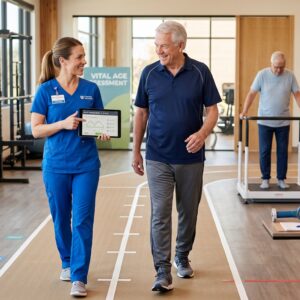
In practical terms: relaxed and low-key. Most people are surprised by how undramatic it is.
There is no exertion that leaves you breathless, no equipment strapped to you, no clinical intensity. The tasks feel almost too simple — “stand up from this chair a few times,” “walk to that line” — which is exactly the point. The power of the assessment is not in how hard the tasks are, but in how precisely they are measured and how much those simple measures reveal.
People who arrive anxious almost always leave relaxed, often a little surprised that the thing they were nervous about was standing up from a chair and walking across a room.
Who Runs the Assessment
The quality of a functional age assessment depends heavily on who administers and interprets it. Standardised tests only produce reliable results when they are delivered consistently — same instructions, same setup, same timing — and the interpretation of the pattern requires clinical understanding, not just arithmetic.
At Resilient80s, the assessment protocol was designed and is reviewed by qualified specialists, and it is who reviews your results that turns a set of raw scores into a clinical picture. A low balance score in a strong 68-year-old means something different from the same score alongside declining grip, and recognising that difference is what interpretation is for.
What You Walk Away With
By the end of the appointment you have:
- Your functional age and the gap between it and your chronological age.
- A domain breakdown — how you scored on strength, balance, gait, grip and stamina, each relative to your age group.
- Your priorities — which one or two domains to work on first, where the return on effort is greatest.
- A retest plan — when to come back and measure progress.
That last point matters. A single assessment is a snapshot; its real value comes from what you compare it to later. Most people are advised to retest at around twelve weeks after starting a programme, then every six to twelve months.
If you would like to understand the scoring behind the breakdown before you attend, our guide to how results are scored explains percentiles and risk categories in plain terms.
Choosing How to Take It
Some assessments can be done at home through a guided process, while others are more precise in a clinical setting. If you are weighing that up, our comparison of choosing between home and clinic testing covers the trade-offs in convenience and accuracy so you can pick the format that fits your situation.
Frequently Asked Questions
What happens during a functional age assessment?
You complete a health questionnaire, then perform a series of simple timed tests — sit-to-stand, a walk test, balance holds, a grip measurement and a short stamina task — before receiving your functional age with a breakdown of your results and priorities. The appointment takes around twenty to thirty minutes.
Is a functional age assessment difficult or tiring?
No. Every task is something you already do in daily life — walking, standing, balancing. Nothing pushes you to exhaustion, and you rest between tasks as needed.
How long does the assessment take?
Most assessments take around twenty to thirty minutes in total, including the questionnaire, the physical tests and the results discussion.
Can I fail a functional age assessment?
There is no pass or fail. The assessment measures where you currently are. A lower result simply means more room to improve and a clearer set of priorities to work on.
Do I need to bring anything?
Bring flat, comfortable shoes, your medication list, and any aids you normally use such as glasses or a walking stick. Wear clothes you can move in easily. Nothing else is required.
Will someone explain my results to me?
Yes. A good assessment ends with someone talking you through your functional age, which domains are strong or weak, and what to prioritise — so you leave understanding your result, not just holding a number.
What if I have a health condition or use a walking aid?
That is fine and expected. The opening questionnaire captures your conditions, tests are modified where needed, and the assessment measures your real capacity including any aids you use — which is exactly what makes the result meaningful for you.
Key Takeaways
- A functional age assessment is a measurement, not an exam — there is no way to fail.
- It runs in a clear sequence: check-in, questionnaire, mobility check, physical tests, results discussion.
- Every physical task is low-intensity and drawn from ordinary daily activity.
- You leave with your functional age, a domain breakdown, your priorities and a retest plan.
- Preparation is minimal: comfortable shoes, your medication list, and any aids you normally use.
Schedule Your Assessment — book in, and know exactly what to expect when you arrive. Schedule Your Assessment