

Functional Age Test at Home vs In-Clinic: Pros and Cons
August 21, 2026 | Functional Age Testing
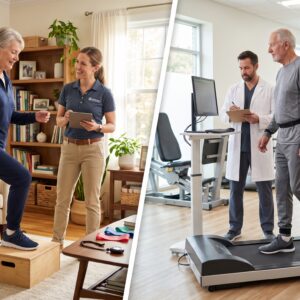
An at-home functional age test offers convenience, comfort and lower cost, while an in-clinic assessment offers greater precision, professional supervision and expert interpretation. For a general baseline and for tracking your own progress over time, a guided at-home test is often sufficient. For maximum accuracy, for people with significant health conditions or fall risk, and for results that feed into important decisions about care or independence, an in-clinic assessment is the stronger choice. Many people use both: a clinic assessment for the accurate baseline, at-home checks in between.
The Real Question Behind This Choice
Before comparing the two, it helps to be clear about what you actually need the result for, because that determines which option is right far more than any general pros-and-cons list.
Ask yourself: is this number going to inform a significant decision, or is it mainly to track my own progress?
If a family is deciding whether a parent can keep living alone, or a result is feeding into a care conversation, precision matters and an in-clinic assessment earns its place. If you simply want to know roughly where you stand and to check whether your training is working, a guided at-home test is often perfectly adequate — and the convenience means you will actually do it repeatedly, which is where the value lies.
Hold that question in mind as you read the comparison.
Side by Side
| Factor | At-Home Test | In-Clinic Assessment |
| Convenience | High — no travel, test on your schedule | Lower — requires an appointment and travel |
| Comfort | High — familiar environment, less nerves | Moderate — clinical setting can raise anxiety |
| Cost | Lower | Higher |
| Precision of measurement | Good for most domains, weaker for some | Highest — calibrated equipment, trained assessor |
| Supervision and safety | Self-directed; needs a helper for balance tasks | Professional supervision throughout |
| Expert interpretation | Guided, often automated | In-person clinical interpretation |
| Suitability with health conditions | Limited if fall risk or complex conditions | Strong — tests modified and supervised |
| Repeatability for tracking | Excellent — easy to redo often | Excellent but less convenient to repeat |
Neither column wins outright. They suit different needs, and the honest answer for most people is “it depends on what you’re using it for.”
The Case for At-Home Testing
Convenience you will actually use
The single biggest advantage of at-home testing is that people do it. A test that requires booking an appointment and travelling across town gets done once a year at best. A guided test you can run in your living room gets done every few months — and, as covered below, the trend across repeated tests is where the real value sits. Convenience is not a minor perk here; it is what makes tracking possible.
Comfort improves accuracy for some measures
Anxiety affects balance and gait — two of the things being measured. Testing in a familiar environment, without the low-level stress of a clinical setting, can actually produce a more representative result for these domains in some people.
Lower cost, lower barrier
At-home testing is less expensive, which lowers the barrier to establishing a baseline in the first place. For someone unsure whether the whole exercise is worthwhile, a low-cost at-home starting point is an easy first step.
Good enough for progress tracking
If you have a solid baseline and simply want to know whether your balance work and strength training are moving the needle, at-home testing tracks change well. You are comparing yourself to yourself, so small differences in setup matter less than they would for an absolute measurement.
You can see how the guided version works and how the at-home version works before deciding whether it suits you.
The Case for In-Clinic Assessment
Precision and calibrated equipment
Some measures — grip strength via a calibrated dynamometer, precisely timed gait over a measured course — are simply more accurate in a clinic. A trained assessor administers each test identically every time, removing the variation that creeps into self-testing. For an accurate absolute baseline, this precision matters.
Professional supervision and safety
Balance testing carries a small but real risk for people who are already unsteady — and those are precisely the people who most need the information. In a clinic, an assessor stays close throughout, so the tests that reveal the most about fall risk can be performed safely. At home, single-leg balance testing without a helper is a genuine hazard.
Expert interpretation
A clinician does not just record numbers; they interpret the pattern. They notice that your gait slowed asymmetrically, that your balance failure came from a specific direction, that your grip and strength scores do not fit the usual pattern and might warrant a closer look. That interpretive layer is difficult to replicate at home.
The right choice when the stakes are high
When a result informs a decision about care, driving, or living independently, the accuracy and clinical context of an in-clinic assessment justify the extra effort and cost. The full testing methodology explains how the in-clinic process achieves this precision.
A Word on Accuracy of Self-Testing
The accuracy of self-testing is the concern people raise most, and it deserves an honest answer.
Self-administered tests are more prone to error in both directions. People instinctively make tasks easier for themselves — cutting a chair rise short, steadying a balance test with a fingertip on the counter, walking a slightly shorter distance than marked. These small compromises inflate results without the person realising.
A well-designed guided at-home test mitigates this with clear instructions, video demonstration and standardised setup. It cannot eliminate it entirely. This is why at-home testing is stronger for tracking change — where the same small biases apply to every test and partly cancel out — than for a precise absolute baseline.
The practical takeaway: if you self-test, follow the instructions exactly, set up the same way every time, and treat the number as a tracking tool rather than a definitive figure.
The Hybrid Approach Most People Should Consider
For many people the best answer is not either/or.
A sensible pattern:
- Establish an accurate baseline in-clinic. Get the precise starting point, the professional interpretation and the safety of supervised balance testing.
- Track progress at home every few months between clinic visits, comparing against your own baseline.
- Return in-clinic annually, or after any significant health event, for a recalibrated accurate measure and a fresh expert review.
This captures the precision of the clinic and the convenience of home, and it means you test often enough for the trend to be meaningful without the friction of booking every check.
The physical tests themselves are largely the same in both settings — our breakdown of the physical tests involved either way covers what you will be doing regardless of where you do it.
Frequently Asked Questions
Is an at-home functional age test accurate?
A well-designed guided at-home test is reasonably accurate for most domains and very good for tracking change over time. It is generally less precise than an in-clinic assessment for absolute measurement, because self-testing introduces small errors and some measures need calibrated equipment.
Can I do balance testing at home safely?
Only with a helper present or sturdy support within reach. Single-leg balance testing is exactly the situation where an already-unsteady person is at risk of falling, so it should never be done alone. In a clinic, an assessor supervises these tests for safety.
Which is better, at-home or in-clinic testing?
It depends on your purpose. For a precise baseline, complex health conditions, or results informing important decisions, in-clinic is better. For convenience, comfort, lower cost and ongoing progress tracking, at-home is often sufficient. Many people use both.
Is an at-home functional age test cheaper?
Generally yes. At-home testing avoids the cost of professional administration, which lowers the barrier to establishing a baseline, though it trades some precision for that saving.
Can I use at-home results to track my progress?
Yes, and this is where at-home testing is strongest. Because you compare each result against your own previous ones, consistent self-testing tracks change well, provided you set up and perform the test the same way every time.
Should I choose in-clinic if I have a health condition or fall risk?
For most people with significant conditions or existing fall risk, in-clinic is the safer and more informative choice, because tests can be modified and supervised and the results interpreted in the context of your health.
Key Takeaways
- The right choice depends on what you need the result for — a decision, or progress tracking.
- At-home testing wins on convenience, comfort and cost, and is strong for tracking change.
- In-clinic assessment wins on precision, safety, and expert interpretation.
- Self-testing introduces small errors that make it better for tracking than for absolute measurement.
- A hybrid approach — accurate clinic baseline, at-home checks between — suits most people well.
Try the At-Home Test — get a convenient baseline you can repeat as often as you like. Try the At-Home Test
Not sure which format fits your situation? Ask which option fits you and we’ll point you in the right direction.