

How Does a Functional Age Test Work? Complete Guide
August 14, 2026 | Functional Age Testing
Quick Answer
A functional age test works in four stages: a short health questionnaire, a series of standardised physical performance tests, scoring of those results against age- and sex-matched population norms, and conversion into a single functional age number. The physical tests typically measure lower-body strength, gait speed, balance, grip strength and stamina. Each raw result is compared with what is normal for each age, and your percentile is translated into the age at which your performance would be average. The whole process takes around twenty to thirty minutes and requires no special preparation.
The Short Version
Before the detail, here is the entire process in five steps:
- You complete a health questionnaire covering medical history, medications and activity levels.
- You perform a set of timed physical tests — walking, chair rises, balance, grip.
- Each result is scored against population norms for your age and sex.
- Your percentiles are converted into ages and combined into one figure.
- The pattern is interpreted so the number comes with an explanation, not just a total.
Now the complete guide to what happens at each stage and why.
Stage 1: The Health Questionnaire
Every credible functional age test begins with information, not exercise. This stage does two jobs.
First, it establishes safety. Before anyone performs balance or strength tasks, the assessment needs to know about conditions that change what is appropriate — recent surgery, cardiac issues, severe arthritis, a history of falls, dizziness, or medications that affect balance and blood pressure. The questionnaire flags anything that means a test should be modified or skipped.
Second, it provides context. Two people can post identical physical scores while being in very different situations. Someone achieving a given result while managing three chronic conditions and five medications is, in functional terms, performing better than the raw number suggests. The health questionnaire lets the interpretation account for this.
Typical questions cover:
- Current medical conditions and past significant illnesses or surgeries
- Medications, particularly those affecting balance, blood pressure or cognition
- Recent falls or near-falls
- Current activity levels and exercise habits
- Sleep, and any relevant nutritional factors
- Specific goals — what you want to be able to keep doing
This stage is not a formality. It is what separates a clinical assessment from a novelty quiz.
Stage 2: The Physical Performance Tests
This is the core of the assessment — a series of standardised, timed tasks. The word “standardised” is doing important work here: each test is administered the same way every time, with the same instructions, the same distances and the same timing method, so that results are comparable between people and between your own tests over time.
The most commonly used physical performance tests are:
Timed sit-to-stand. You rise from a chair to standing and sit back down, either a set number of times as fast as safely possible, or as many times as you can in thirty seconds. This measures lower-body strength and power — the capacity behind climbing stairs, getting off the toilet and recovering from a stumble.
Gait speed. You walk a measured distance at your comfortable pace, and the time is recorded. Walking integrates the cardiovascular, muscular, neurological and sensory systems, which is why this single measurement is one of the most powerful predictors in geriatric medicine.
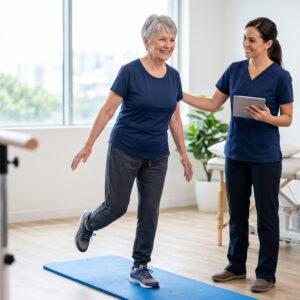
Balance test. Usually a progression: feet together, then one foot slightly ahead (semi-tandem), then heel-to-toe (tandem), then single-leg stance. How long you can hold each position reflects vestibular function, proprioception and reflex speed, and correlates closely with fall risk.
Grip strength. Measured with a hand dynamometer — you squeeze as hard as you can. Grip is a proxy for total-body muscle quality and one of the most validated health predictors in large population studies.
Stamina and recovery. Depending on the protocol, a short walking or stepping task that measures aerobic capacity and, importantly, how quickly your heart rate recovers afterward.
None of these is strenuous beyond normal daily activity. There is no treadmill stress test, no maximal exertion, and every task can be modified for people with mobility limitations. The physical performance test methodology walks through exactly how each one is administered and scored.
Stage 3: Scoring Against Norms
This is the stage that turns raw numbers into a meaningful result, and it is where a real assessment differs most from a self-test.
A raw result on its own is meaningless. Holding a single-leg stance for twelve seconds is neither good nor bad until you know what twelve seconds represents for your age and sex. Rising from a chair fourteen times in thirty seconds means nothing without a reference point.
That reference point comes from normative data — large datasets showing what performance actually looks like across the population at each age band and for each sex. Your raw score is placed against this distribution to find your percentile: the proportion of people your age and sex you are outperforming.
Norms are separated by sex because male and female averages differ meaningfully in strength and some other domains, and by age band because the whole point is to compare like with like. Scoring a 70-year-old’s grip against a 40-year-old’s average would be meaningless; scoring it against other 70-year-olds is exactly the point.
Stage 4: Converting to a Functional Age
Once each domain has a percentile, the conversion works like this:
Your percentile in a given domain is matched to the chronological age at which that level of performance is average. If your balance performance is typical of an average 78-year-old, your “balance age” is 78 — even if you are 66.
Each domain therefore produces its own age. The domain ages are then weighted — according to how strongly each predicts real outcomes like disability and survival — and combined into a single functional age.
The weighting matters. Gait speed and lower-body strength carry more predictive weight than flexibility, so they influence the final number more. A good assessment does not simply average the domains; it weights them by how much each actually tells you about your future.
The result is one number you can understand and act on, sitting on top of a domain breakdown that tells you where it came from.
Stage 5: Interpretation
The final and most important stage: someone who understands what the results mean reviews the pattern, not just the total.
This matters because identical functional ages can mean completely different things. A functional age of 74 driven mainly by poor balance in an otherwise strong 66-year-old points to a specific falls-risk profile and a balance-first intervention. The same 74 driven by low grip strength and poor aerobic recovery, with good balance, suggests sarcopenia and deconditioning — a different problem needing a different response.
Interpretation is what converts a number into a plan. Without it, you have a score. With it, you have a starting point, a priority, and a reason to retest.
A functional age test that hands you a number and nothing else has done half the job. The number is only useful once someone explains which domains produced it and what to do about them.
What You Need to Do to Prepare
Very little, which is part of the appeal.
- Wear comfortable clothes and flat, secure footwear. You will be walking, standing and rising from a chair.
- Bring a list of your medications, or the details to hand for the questionnaire.
- Do not do a hard workout immediately beforehand — you want your results to reflect your normal capacity, not fatigue.
- Eat and hydrate normally. This is not a fasting test.
- If you use a walking aid or glasses, bring them. The test measures your real functional capacity, which includes the aids you normally use.
That is genuinely all. There is no fasting, no blood draw in the core assessment, and nothing to revise for.
Where and How You Can Take It
Functional age testing can be done in a clinical setting, where a trained assessor administers each test, or through a guided at-home version for some of the measures. Each has trade-offs around convenience and precision, which are worth understanding before you choose.
If you would like to go straight to it, you can start the test online and follow the guided process. For a preview of the experience itself — what the room looks like, how long each part takes, what the assessor does — read what your session will actually involve before you book.
And if you are still weighing up whether the exercise is worth it at all, the short answer is that the tests behind this number are among the strongest available predictors of independence and survival in older adults — which is why this number matters more than most health metrics people track.
Frequently Asked Questions
How does a functional age test work?
It works in four stages: a health questionnaire, a series of standardised physical tests (typically sit-to-stand, gait speed, balance and grip strength), scoring those results against age- and sex-matched population norms, and converting your percentiles into a single functional age. Interpretation of the pattern follows.
What tests are included in a functional age assessment?
The core physical tests usually include a timed sit-to-stand for lower-body strength, a measured walk for gait speed, a balance progression, a grip strength measurement, and a short stamina and recovery task. A health questionnaire accompanies them.
How long does a functional age test take?
Most assessments take around twenty to thirty minutes in total, including the questionnaire and all the physical tasks.
Do I need to prepare for a functional age test?
Very little preparation is needed. Wear comfortable clothes and flat shoes, bring your medication list and any walking aids or glasses you normally use, and avoid a hard workout immediately beforehand so your results reflect your normal capacity.
Is a functional age test safe?
Yes. The tests are low-intensity, no more demanding than normal daily activity, and the opening questionnaire flags any condition that means a specific test should be modified or skipped.
How accurate is a functional age test?
Accuracy depends on the tests used and the norms they are scored against. Assessments built on validated measures — gait speed, sit-to-stand, grip dynamometry, balance testing — are well supported by research. Single-question online quizzes are not comparable.
Can I take a functional age test at home?
Some of the measures can be done through a guided at-home version, while others are more precise in a clinical setting. The right choice depends on how much precision you need and how easily you can access a clinic.
Key Takeaways
- A functional age test runs in four stages: questionnaire, physical tests, scoring against norms, conversion to a number.
- The physical tests measure strength, gait speed, balance, grip and stamina — none strenuous.
- Scoring against age- and sex-matched norms is what makes a raw result meaningful.
- Domains are weighted by how strongly each predicts outcomes, not simply averaged.
- Interpretation of the pattern turns the number into an actionable plan.
Take the Test Now — walk through the guided process and get your functional age today. Take the Test Now