
Signs Your Balance Is Putting You at Risk of Falling
September 24, 2026 | Balance & Fall Prevention
The early warning signs of poor balance in seniors include feeling unsteady on your feet, holding onto furniture or walls to move around, dizziness when standing up, widening your stance to feel stable, difficulty standing on one leg, and any near-falls or trips. These signs appear before a serious fall and are the body’s early warning system. Noticing them is genuinely good news – it means there is still time to act, because balance responds quickly to training when the decline is caught early.
Why These Signs Matter So Much
Balance declines silently. The systems that keep you steady can weaken for years without any obvious symptom, because everyday life on flat, familiar floors barely tests them. Then one day a situation demands more than you have left, and a fall happens that seems to come from nowhere.
Except it usually doesn’t come from nowhere. In hindsight, the warning signs were almost always there – a hand reaching for the wall, a moment of dizziness on standing, a stumble brushed off as clumsiness. The problem is that these signs are easy to dismiss or rationalize until something serious happens.
That is exactly why learning to recognize them matters. Each sign is your body telling you that your balance reserve is running low while there is still time to rebuild it. Spotting them early turns a future fall into a problem you solved in advance.
Sign 1: Feeling Unsteady on Your Feet
The most direct sign is the simplest: a general sense of being unsteady on your feet. This might feel like swaying, a sense that you could tip over, or just a vague lack of confidence when standing or walking.
Many people normalise this as “just getting older” and stop noticing it. But persistent unsteadiness is not something to accept – it is a signal that one or more of your balance systems needs attention. If you regularly feel less than solid on your feet, treat it as information, not inevitability.
Sign 2: Reaching for Furniture and Walls
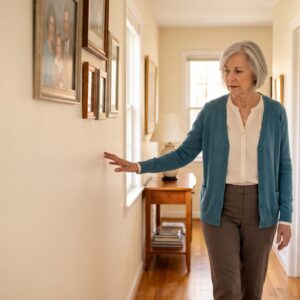
Watch how you move through your home. If you find yourself touching the wall along a hallway, steadying yourself on furniture as you pass, or gripping the counter more than you used to, that is a meaningful sign.
This behaviour, sometimes called “furniture walking”, is your body compensating for reduced balance by borrowing stability from your surroundings. It is so automatic that many people do it without realising. Ask yourself honestly: could you cross your living room confidently without touching anything? If not, your balance is already flagging.
Sign 3: Dizziness, Especially When Standing
Dizziness is a common and important warning sign, and it comes in a few forms worth distinguishing:
- Light-headedness on standing upoften points to a blood-pressure drop (a very common, often treatable issue) – the room seems to swim briefly when you rise from sitting or lying.
- A spinning sensation (vertigo)frequently points to an inner-ear or vestibular cause.
- General unsteadiness or fogginesscan stem from several sources, including medications.
Any recurring dizziness is worth mentioning to your GP, because much of it is addressable once the cause is identified. Dizziness that makes you grab for support is a particularly clear fall-risk signal. A common underlying cause is inner-ear decline, which we cover in a common underlying cause.
Sign 4: Widening Your Stance
People with declining balance often, without noticing, start standing and walking with their feet further apart. A wider base of support feels more stable, so the body adopts it automatically to compensate.
If you notice you now stand with feet spread wider than you used to, or that walking with feet close together feels precarious, that instinctive adjustment is a sign your balance margin has narrowed. It is the body’s own workaround for a system that needs strengthening.
Sign 5: Difficulty Standing on One Leg
A simple self-check: holding support nearby for safety, can you comfortably stand on one leg? Difficulty here – or being unable to hold it for even a few seconds – is one of the more reliable indicators of reduced balance and elevated fall risk.
Single-leg balance demands that all your stability systems work together, so struggling with it reveals decline that flat-ground walking hides. If this is hard, it is a strong prompt to start balance training and to consider a formal assessment. (Always do this check beside a wall or sturdy chair.)
Sign 6: Near-Falls, Trips and Stumbles
Perhaps the most important sign, and the most often dismissed: near-falls. A trip you caught yourself from, a stumble on a step, a wobble that made your heart race – these are not lucky escapes to be forgotten. They are dress rehearsals for a fall.
A near-fall means a situation exceeded your balance reserve, and you happened to recover this time. The next similar moment might not end as well. Take each near-fall seriously: it is among the clearest predictors that a real fall could follow, and among the loudest calls to act now.
Every one of these signs is a gift of time. The body warns before it falls – and balance, caught early, is one of the most improvable things in the whole of ageing.
What to Do If You Recognise These Signs
Recognising one or more of these signs is not cause for alarm – it is cause for action, and the action is very achievable.
First, don’t restrict your life. The instinct after noticing unsteadiness is to move less and be more careful. But moving less weakens the very systems that keep you steady, making balance worse. The answer is targeted training, not avoidance.
Start balance training. Balance responds faster to exercise than almost any other ability, often within a fortnight. Gentle, progressive practice re-sharpens your stability systems.
Address dizziness with your GP. If dizziness is one of your signs, get it investigated – the cause is frequently treatable.
Get an objective measure. Self-assessment is unreliable, and these signs tell you *that* there’s a problem, not *how big* it is or exactly which system is failing. A formal balance test gives you that detail. Our guide covers a formal way to check this using safe, validated tests.
For the complete strategy – exercise, home safety, medication and vision – see our full fall prevention guide, and to turn these warning signs into an objective score you can act on, you can get a complete risk picture.
Frequently Asked Questions
What are the signs of poor balance in seniors?
The main early signs are feeling unsteady on your feet, reaching for furniture or walls to move around, dizziness (especially when standing), widening your stance for stability, difficulty standing on one leg, and any near-falls, trips or stumbles.
Is being unsteady on your feet a sign of a serious problem?
Persistent unsteadiness shouldn’t be dismissed as just ageing. It signals that one or more balance systems needs attention, and it’s often addressable. Recurring unsteadiness combined with dizziness is worth raising with your GP.
Should I worry about near-falls if I didn’t actually fall?
Yes – near-falls are among the clearest predictors of a future fall. A near-fall means a situation exceeded your balance reserve and you happened to recover. Treat each one as a prompt to start balance training and get assessed.
Why do I feel dizzy when I stand up?
Light-headedness on standing often reflects a temporary drop in blood pressure, which is common and frequently treatable. A spinning sensation more often points to an inner-ear cause. Recurring dizziness of any kind is worth investigating with your GP.
Can I test my own balance at home?
You can do a simple check – standing on one leg beside a wall or sturdy chair for safety – to get a rough sense. For an accurate picture of which systems are struggling and how much risk you carry, a formal balance assessment is more reliable.
What should I do if I notice these warning signs?
Don’t reduce your activity, which worsens balance. Instead, start gentle progressive balance training, have any dizziness checked by your GP, and get an objective balance assessment to target the specific weakness and track improvement.
Key Takeaways
- Balance decline is silent, but it leaves warning signs before a fall happens.
- Key signs: unsteadiness, furniture-walking, dizziness, a widened stance, one-leg difficulty, near-falls.
- Near-falls are the most important and most dismissed sign – treat each as a warning.
- Don’t respond by moving less; that worsens balance. Respond with targeted training.
- Recognising the signs is good news – balance caught early is highly improvable.
Get Screened Today – turn these warning signs into an objective score and a clear plan. Get Screened Today