
How to Fall-Proof Your Home After 60
September 25, 2026 | Balance & Fall Prevention
To fall-proof your home after 60, work room by room: improve lighting everywhere (with night lights on the bedroom-to-bathroom route), remove or secure loose rugs and clutter, fit grab bars by the toilet and in the shower, add handrails on both sides of stairs, and wear supportive non-slip footwear indoors. Most of these fixes are inexpensive, quick to install and permanent. Because falls at home usually happen where a hazard meets a moment of reduced balance, removing the hazards protects you even on your less steady days.
Why Home Safety Is Half the Battle
You can have well-trained balance and still be brought down by a hazard you never saw – a rug edge, a dark step, a wet floor. That is why fall prevention has two halves: strengthening the body, and removing the obstacles it has to navigate. This guide is the second half.
The logic is simple. Falls happen when a demand on your balance exceeds your reserve. Training raises your reserve; home safety for elderly living lowers the demands. Do both and the gap between them – the danger zone – shrinks dramatically. Home fixes have a particular advantage: once done, they protect you every single day, including the days you’re tired, unwell or momentarily distracted.
The best part is that most changes are cheap, fast and don’t require a builder. Let’s go room by room.
Every Room: Lighting and Floors
Two fixes apply throughout the house and deliver the biggest return, so start here.
Lighting
Poor lighting turns minor hazards into serious ones by hiding them. As we age, our eyes need more light and adjust more slowly between bright and dark, so good, even lighting matters more than ever.
- Increase brightness throughout, especially in hallways, stairwells and entrances.
- Fit night lights along the route from bedroom to bathroom – the single most common night-time fall path.
- Put a lamp or switch within reach of the bed so you’re never crossing a dark room.
- Consider motion-activated lights for hallways and bathrooms.
Floors and walkways
Clear, uncluttered floors are the foundation of a safe home. Tripping hazards on the floor cause a large share of home falls.
- Remove loose rugs, or secure them with non-slip backing and tape down the edges.
- Keep walkways clear of clutter, boxes and pet items.
- Route electrical cords along walls, never across floors.
- Wipe up spills immediately, and take extra care on tiled or polished floors.
The Bathroom: Highest Risk, Highest Priority
The bathroom is where many serious home falls happen – wet, hard surfaces and lots of sitting, standing and turning make it the riskiest room. It also benefits most from a few well-placed fixes.
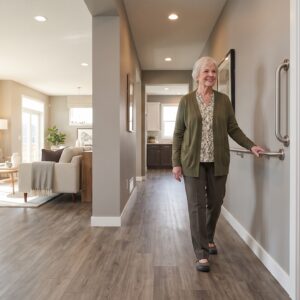
Grab bars are the single most valuable addition. Properly installed (screwed into studs or with heavy-duty fixings, not suction cups for weight-bearing), they give you something solid to hold at the two riskiest moments: getting on and off the toilet, and getting in and out of the shower or bath.
- Fit a grab bar beside the toilet and inside the shower/bath.
- Use a non-slip mat inside the shower or bath and a non-slip bath mat outside it.
- Consider a shower seat or bench so you can wash seated.
- A raised toilet seat reduces how far you have to lower and lift yourself.
- Keep everything you need within easy reach so you’re not stretching or turning awkwardly.
Stairs and Hallways
Stairs concentrate risk because a fall there tends to be more serious. A few changes make them much safer.
- Handrails on both sides where possible, securely fixed, running the full length of the stairs.
- Good lighting at the top and bottom, with switches at both ends so you never climb in the dark.
- Contrast marking on step edges if they’re hard to distinguish – a strip of contrasting tape helps you judge each step.
- Keep stairs completely clear – never use them as temporary storage.
- Non-slip treads on smooth or wooden steps.
In hallways, keep the path clear and well-lit, and make sure any runners or mats are secured flat.
The Bedroom
Because night-time trips to the bathroom are a common fall scenario, the bedroom deserves specific attention.
- Keep a lamp or light switch within arm’s reach of the bed.
- Clear a direct, uncluttered path from bed to door.
- Ensure the bed is at a height that lets you sit and stand easily – neither too low nor too high.
- Keep a phone within reach in case of a fall.
- Avoid long dressing gowns or bedding that can trail and catch your feet.
The Kitchen
The kitchen combines spills, reaching and hard floors, so a few habits and fixes help.
- Store everyday items at waist-to-shoulder height to avoid reaching high or bending low.
- Never stand on chairs or stools to reach – keep a stable step stool with a handrail if you must, or better, rearrange so you don’t need to.
- Clean spills immediately; keep a non-slip mat by the sink.
- Wear supportive shoes rather than socks or slippers on kitchen floors.
Footwear: The Fix You Wear
Home safety isn’t only about the building – what’s on your feet matters throughout it. Supportive, well-fitting shoes with non-slip soles give you grip and stability that slippers, socks and worn-out shoes cannot.
- Choose shoes that fit snugly with a firm, non-slip sole and a supportive back.
- Avoid backless slippers, loose slip-ons and walking in socks or tights on smooth floors.
- Replace shoes with worn, smooth soles.
It’s a small change that works in every room, every day.
A fall-proofed home protects you on your worst days, not just your best ones. That’s what makes it such a high-value investment of an afternoon.
A Simple Room-by-Room Checklist
Walk through your home with this list:
- Lighting – bright and even everywhere, night lights on the bathroom route.
- Floors – no loose rugs, clutter or trailing cords.
- Bathroom – grab bars fitted, non-slip mats down, shower seat if needed.
- Stairs – handrails both sides, well-lit, edges marked, kept clear.
- Bedroom – light within reach, clear path to the door.
- Kitchen – everyday items within easy reach, spills cleaned promptly.
- Footwear – supportive, non-slip shoes worn indoors.
Home safety is one essential part of staying independent at home as you age – it works hand in hand with keeping yourself strong and steady. Our guide to how this supports staying independent puts it in the bigger picture, and for larger or structural changes, see deeper home modification ideas.
If you’d like tailored guidance for your specific home and needs, you’re welcome to ask about a home safety consult.
Frequently Asked Questions
How do I fall-proof my home for seniors?
Work room by room: improve lighting throughout (with night lights on the bedroom-to-bathroom route), remove or secure loose rugs and clutter, fit grab bars by the toilet and in the shower, add handrails on both sides of stairs, and wear supportive non-slip shoes indoors.
What is the most important home change to prevent falls?
Improving lighting and fitting bathroom grab bars deliver the most protection for the least cost. The bathroom is the highest-risk room, and good lighting prevents falls throughout the whole home by making hazards visible.
Where do most falls happen at home?
The bathroom is one of the most common and most serious locations because of wet, hard surfaces and the frequent sitting, standing and turning. Stairs and the night-time route between bedroom and bathroom are other high-risk spots.
Are suction-cup grab bars safe?
Suction-cup bars are only for light steadying, not for taking your weight. For genuine fall protection, grab bars should be permanently fixed into wall studs or with heavy-duty fixings by someone competent to install them.
Do rugs really cause falls?
Yes. Loose rugs and mats are a leading tripping hazard. Either remove them or secure them fully with non-slip backing and taped-down edges so they can’t slide or curl at the corners.
How much does it cost to fall-proof a home?
Most high-impact changes – night lights, securing rugs, clearing clutter, non-slip mats, supportive footwear – are inexpensive. Grab bars and handrails cost a little more if professionally fitted, but remain modest relative to the cost of a fall.
Key Takeaways
- Home safety is the second half of fall prevention – it lowers the demands on your balance.
- Lighting and clear floors deliver the biggest return and apply to every room.
- The bathroom is the highest-priority room; grab bars are the single best addition.
- Stairs and the night-time bathroom route are key danger spots to address.
- Supportive non-slip footwear protects you in every room, every day.
Request a Consultation – get tailored home-safety and fall-risk guidance for your situation. Request a Consultation