

Balance Tests for Seniors: What They Reveal About Aging
September 9, 2026 | Uncategorized
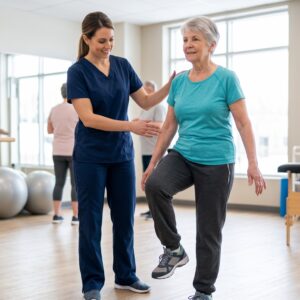
Balance tests for seniors – such as the single-leg stance, tandem stance and the Timed Up and Go – measure postural control and reveal fall risk long before a fall happens. Balance depends on three systems working together: the inner ear (vestibular function), the body’s position sense (proprioception) and vision. All three decline with age, often silently, because everyday life rarely challenges balance until something goes wrong. A simple balance screening surfaces that hidden decline while it is still very responsive to training.
Why Balance Is the Domain Nobody Sees Coming
Ask most older adults how their balance is, and they’ll say it’s fine – right up until the day it isn’t.
That’s the defining problem with balance: it’s invisible in daily life. You don’t test your balance walking across a level kitchen or sitting down to dinner. Your reserve can erode for years without producing a single noticeable symptom, because ordinary activities simply don’t demand much of it. Then a moment comes that does – an uneven kerb, a wet floor, a rug edge in poor light – and the reserve isn’t there to recover.
This is exactly why a balance test for seniors is so valuable. It deliberately challenges the system in a controlled, safe way, surfacing a decline that self-assessment almost always misses. Of all the components of functional testing, balance is the one people most often score worst on despite feeling perfectly steady.
To see how it sits within the wider assessment, here’s how balance fits into the full test.
What Balance Actually Depends On
Balance isn’t one thing. It’s the product of three separate systems working together, and a good balance screening reveals when any of them is faltering.
The vestibular system (inner ear). Tiny structures in your inner ear sense head position and movement. As vestibular function declines with age, the brain gets noisier signals about where your head is in space — a common and under-recognised cause of unsteadiness and dizziness in older adults.
Proprioception (position sense). This is your body’s ability to sense where your limbs are without looking. Proprioception relies on sensors in your muscles and joints, and it dulls with age, meaning your brain has a less accurate map of your own body to balance with.
Vision. Your eyes provide the reference for “which way is up”. This is why balance feels harder in the dark or with eyes closed — remove the visual input, and the other two systems have to do all the work. Balance tests that include an eyes-closed condition are specifically probing how well you cope when vision can’t compensate.
When all three are healthy, balance is effortless and automatic. When one declines, the others compensate – until they can’t. A balance test finds out how much compensation you have left.
The Main Balance Tests for Seniors
Here are the balance tests most commonly used, what each reveals, and how they’re performed. Always do these beside a wall or sturdy chair, and ideally with someone nearby – the point is to find your limit, which carries a small, deliberate risk of a wobble.
The single-leg stance test
The single-leg stance test is the classic balance measure. You stand on one leg, hands on hips or by your sides, and time how long you can hold it before touching down or grabbing support.
It’s a demanding test precisely because it removes half your base of support, forcing all three balance systems to work hard. Difficulty holding a single-leg stance is one of the more reliable indicators of elevated fall risk, and the time you can hold generally declines with age – which is what makes it useful for tracking.
The tandem stance
You stand heel-to-toe, one foot directly in front of the other, as if on a tightrope, and hold. This narrows your base of support front-to-back and challenges the fine control that keeps you steady when walking in a straight line.
The Timed Up and Go (TUG)
You rise from a chair, walk three metres, turn, walk back and sit down – all timed. The TUG is a dynamic test, capturing balance *in motion* along with the strength and coordination that real-world movement requires. It’s widely used because it mirrors a genuine daily sequence and predicts mobility problems well.
The functional reach test
Standing side-on to a wall, you reach forward as far as you can without stepping or losing balance, and the distance is measured. It assesses how far you can shift your centre of gravity while staying stable — the same control you use reaching for a high shelf or leaning to pick something up.
What Your Results Reveal
A balance test result does two things: it places you against age norms, and it flags fall risk.
Poor performance doesn’t mean you’re destined to fall. It means your current profile places you in a group with elevated risk — and, importantly, it identifies *which* part of balance is struggling. Difficulty only with eyes closed points toward proprioception or vestibular reliance on vision. Difficulty with dynamic tests like the TUG points toward the strength-and-coordination side. That distinction shapes what you work on.
Falls are worth taking seriously because of what they lead to: they’re the leading route to fracture, hospitalisation and permanent loss of independence in older adults. A balance test is, in effect, an early-warning system for that entire chain of events — and it fires while there’s still ample time to respond.
If your balance test suggests decline, the underlying causes are worth understanding, which we cover in why this ability fades over time.
The Good News: Balance Responds Fast
Here’s what makes balance the most rewarding domain to work on: of all the components of functional age, it responds the quickest and needs the least.
Balance training requires no equipment, takes only a few minutes a day, and produces measurable improvement within weeks. Multiple systematic reviews of exercise programmes for older adults have found that balance-challenging exercise reduces the rate of falls in community-dwelling older people — a rare example of a simple, cheap intervention with strong evidence behind it.
The approach is straightforward progression: start with what’s safely challenging (feet together, then tandem stance), and advance as you improve (single-leg, then eyes closed with support nearby). The nervous system adapts surprisingly fast, which is why people who commit to a few minutes daily often notice they feel steadier within a fortnight.
Because it’s the highest-leverage domain for most people, our guide to the exercises that rebuild it is the natural next step after testing.
Balance is the domain that declines most quietly and improves most quickly. That combination — hidden risk, fast reward — is exactly why it’s worth testing and training.
How Often to Test Your Balance
Balance is worth checking as part of your regular functional age testing — annually for general monitoring, and every few months if you’re actively working to improve it or you’ve had a fall or near-fall.
If you’re doing balance training, retesting every four to eight weeks is reasonable, since balance improves fast enough that shorter intervals still show real change rather than just noise.
For a properly scored balance assessment against validated norms — rather than a rough self-timed attempt — you can check your own balance score as part of a full functional age test.
Frequently Asked Questions
What is a balance test for seniors?
A balance test for seniors is a simple, timed assessment of postural control — such as the single-leg stance, tandem stance or Timed Up and Go — used to measure fall risk and detect age-related balance decline before a fall occurs.
How long should a senior be able to stand on one leg?
Norms vary by age, but being able to hold a single-leg stance comfortably for around 10 seconds or more is a common reassurance threshold in older adults. Difficulty holding it is a recognised indicator of elevated fall risk and warrants attention.
What causes balance problems in seniors?
Balance depends on three systems — the vestibular system in the inner ear, proprioception (position sense) and vision — all of which decline with age. Muscle weakness, certain medications and some medical conditions can also contribute.
Are balance tests safe to do at home?
They can be, with precautions: always test beside a wall or sturdy chair, and ideally with someone present, since the tests are designed to find your limit. Anyone with a significant falls history is better served by supervised testing.
Can balance be improved in older adults?
Yes, and quickly. Balance training needs no equipment, takes minutes a day, and produces measurable improvement within weeks. Systematic reviews show balance-challenging exercise reduces fall rates in community-dwelling older adults.
How often should seniors have their balance tested?
Annually as part of general functional monitoring, every few months when actively training to improve it, and promptly after any fall or near-fall. During active balance training, retesting every four to eight weeks captures real progress.
Key Takeaways
- Balance declines silently because daily life rarely challenges it — until a fall reveals the loss.
- It depends on three systems: vestibular function, proprioception and vision.
- Core tests include the single-leg stance, tandem stance, Timed Up and Go and functional reach.
- Results flag fall risk and identify which part of balance is struggling.
- Balance responds faster to training than any other domain — hidden risk, fast reward.
Test Your Balance Now – get a scored balance assessment against proper norms and see your fall-risk picture. Test Your Balance Now