

5 Physical Tests That Reveal Your True Functional Age
August 24, 2026 | Functional Age Testing
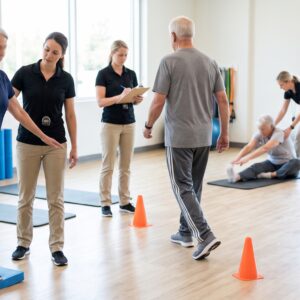
Five physical tests reveal most of your functional age: the sit-to-stand test (lower-body strength), gait speed (whole-body integration), a balance test (fall risk), grip strength (muscle quality), and a stamina test (cardiovascular fitness). Each one is quick, needs little or no equipment, and predicts real-world outcomes such as independence, fall risk and even survival. Together they capture the domains that decline first and matter most — which is why they form the backbone of any credible functional age assessment.
Why These Five
Ageing does not show up evenly. One person loses balance first, another loses leg strength, a third quietly loses aerobic capacity while everything else holds. That is why no single test captures functional age — you need a handful that, between them, cover the domains that decline and matter.
These five were chosen not because they are difficult but because decades of research tie them to hard outcomes: falls, hospitalisation, loss of independence and survival. They are the tests geriatric medicine actually relies on, stripped of jargon.
You can try each at home to get a rough sense of where you stand, but a scored result needs proper norms. Here is how each fits into how these tests fit into the full assessment.
Test 1: The Sit-to-Stand Test
What it measures: lower-body strength and power.
How it works: sit in a sturdy chair, arms crossed over your chest, and stand fully then sit back down as many times as you can in thirty seconds — without using your arms.
Why it matters: the sit-to-stand test is one of the most informative single tests in the whole battery. The leg power it measures is the same power you use to climb stairs, get off the toilet, rise from a car seat and recover from a stumble. When this score falls, the list of things you can no longer do unaided starts to grow — which is why it is such an early warning of declining independence.
Rough guide: many normative sets place a healthy adult in their sixties somewhere in the region of 12 or more repetitions, with fewer than around 8 warranting attention — but ranges vary by age, sex and the exact protocol, so treat any self-count as indicative only.
Test 2: Gait Speed
What it measures: whole-body integration — the combined health of your muscles, joints, heart, lungs, nervous system and senses.
How it works: mark a set distance (four metres is standard), walk it at your normal comfortable pace, and time the middle portion so acceleration and deceleration don’t distort the result.
Why it matters: gait speed is the closest thing geriatric medicine has to a single vital sign for ageing. Walking looks simple but demands the coordinated function of nearly every system, so when any of them degrades, speed drops. A landmark 2011 pooled analysis in *JAMA*, covering more than 34,000 older adults, found walking speed consistently predicted survival — with large differences in life expectancy between slow and fast walkers of the same age and sex.
Rough guide: a comfortable pace at or above roughly 1.0 metre per second is generally reassuring in older adults; markedly slower speeds are associated with higher risk. Again, this is indicative, not a diagnosis.
Test 3: The Balance Test
What it measures: postural control, and by extension your fall risk.
How it works: a balance test progresses through increasing difficulty — feet together, then heel-to-toe (tandem stance), then single-leg stance — each held for a set time, always beside a wall or sturdy chair for safety.
Why it matters: balance reserve is invisible in daily life until the moment it runs out, which is why almost nobody can accurately judge their own. Poor balance is closely tied to falls, and falls are the leading route to fracture, hospitalisation and permanent loss of independence in older adults. Of the five, this is the domain people most often score worst on despite feeling fine — precisely because everyday life so rarely tests it.
Rough guide: being able to hold a single-leg stance comfortably for around 10 seconds or more is a common reassurance threshold in older adults, though norms vary. Difficulty here deserves attention even if nothing else does. For a deeper look at this one component, see a closer look at the balance component.
Test 4: Grip Strength
What it measures: whole-body muscle quality — not just hand strength.
How it works: squeeze a handheld dynamometer as hard as you can, typically two or three times per hand, and the best reading is recorded.
Why it matters: grip strength punches far above its weight as a predictor. It reflects overall muscle mass, neuromuscular function and even nutritional status, which is why it appears in so many major studies. The PURE study, published in *The Lancet* in 2015 with almost 140,000 participants, found grip strength to be a stronger predictor of cardiovascular death than systolic blood pressure. It is quick, objective and very hard to fake — making it one of the most efficient measures in the set.
Rough guide: normative grip values differ substantially by age and sex, so a meaningful reading requires comparison against the right reference table rather than a single universal number.
Test 5: The Stamina Test
What it measures: cardiovascular fitness and endurance.
How it works: a stamina test is usually a timed walk (such as how far you can walk in six minutes) or a step test, followed by measuring how quickly your heart rate recovers. It is paced to your ability and stops well short of exhaustion.
Why it matters: stamina determines whether you can complete everyday tasks — a flight of stairs, a walk to the shops, carrying luggage — without needing to stop and rest. Aerobic capacity declines by roughly 10% per decade in sedentary adults, and recovery speed is an under-appreciated marker of cardiovascular health. Low stamina is often what turns a manageable day into an exhausting one.
Rough guide: distance covered and recovery time are both compared to age and sex norms; the trend in your own results over time is often more informative than any single figure.
A Note on the Mobility Test for Seniors
Beyond the core five, a good assessment adds a mobility test for seniors — a check of joint range of motion. Simple reaches and rotations reveal whether your joints allow the movements daily life requires: dressing, reaching overhead, and turning to check a blind spot while driving.
It is not always counted among the “big five” because it predicts outcomes less powerfully than gait speed or grip strength, but restricted mobility quietly undermines independence and often explains difficulties people had not linked to their joints at all.
Each test is a window onto a different system. No single one defines you — but together, these five see almost everything that matters about how your body is ageing.
What to Do With Your Results
Trying these at home gives you a rough sense of your strengths and weak points. The value comes from turning that into action.
The general principle: work on your weakest domain first. If balance was your low point, balance training pays off fastest and requires no equipment. If it was the sit-to-stand, progressive lower-body strength work is the priority. General activity produces general results; targeting the specific domain that scored low produces measurable change.
Because balance and lower-body strength are the two that most often need attention — and respond quickest — our guide to the exercises that improve these results is the natural next step once you know where you stand.
For a properly scored version of all five, against validated norms rather than rough self-estimates, you can put these tests to work in a full assessment.
Frequently Asked Questions
What physical tests measure functional age?
The five core tests are the sit-to-stand (lower-body strength), gait speed (whole-body integration), a balance test (fall risk), grip strength (muscle quality) and a stamina test (cardiovascular fitness). A mobility check of joint range of motion is often added.
Can I test my functional age at home?
You can perform rough versions of most of these tests at home with just a chair, a measured distance and a timer, which gives an indicative sense of your strengths and weaknesses. A scored functional age requires comparison against validated population norms.
Which physical test is the best single predictor of ageing?
Gait speed is the most widely cited single predictor, because walking integrates nearly every body system into one measurable output. Grip strength is a close second and is easier to standardise in clinical settings.
What is a good sit-to-stand score for a senior?
It varies by age, sex and protocol, but many normative sets place a healthy adult in their sixties around 12 or more repetitions in thirty seconds, with fewer than roughly 8 warranting attention. Treat any self-count as indicative rather than definitive.
How often should I do these tests?
Establishing a baseline, then retesting every three to twelve months, captures meaningful change while avoiding the day-to-day variation that more frequent testing would pick up.
Are these physical tests safe to do at home?
The strength, gait and stamina tests are generally safe for most people. The balance test carries a small fall risk by design, so perform it beside a wall or sturdy chair and, ideally, with someone present — especially if you have a falls history.
Key Takeaways
- Five tests — sit-to-stand, gait speed, balance, grip strength, stamina — capture most of functional age.
- Each is quick, needs little equipment, and predicts real-world outcomes.
- Balance and lower-body strength are the domains most often weak, and both respond fast to training.
- Home versions give a rough sense; validated norms give a true score.
- Work on your weakest domain first — targeted effort beats general activity.
Get Tested Today — get all five scored against proper norms and see your true functional age. Get Tested Today